Last updated:
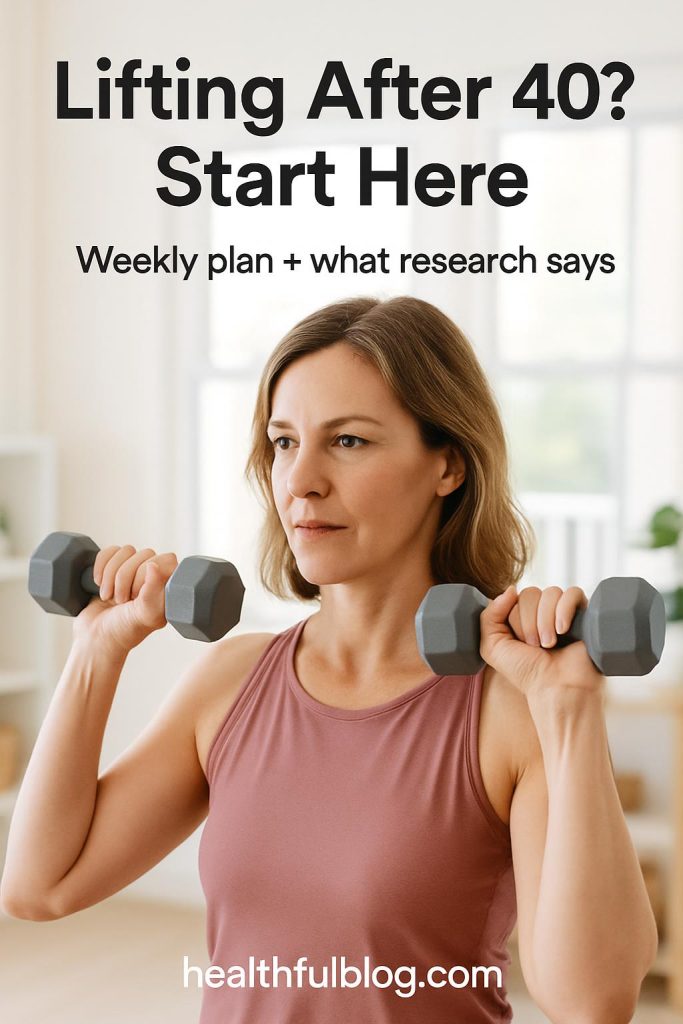
If you are starting strength training for women over 40, you are doing one of the most useful things you can for the next few decades. Muscle and bone quietly decline with age, and lifting weights is the most direct way to push back. You do not need a gym membership, heavy barbells or an hour a day. This guide covers why it matters, how often to train, a simple full-body routine you can do at home, and what the research does and does not show about menopause and bones.
- Most people begin losing muscle around age 30, at about 3% to 5% per decade, according to Harvard Health, and strength training helps slow that loss.
- The Physical Activity Guidelines for Americans recommend muscle-strengthening activity for all major muscle groups on 2 or more days a week.
- A beginner can start with 2 to 3 sets of 8 to 12 repetitions per exercise, with at least 24 hours of rest between sessions for the same muscles.
- Research on exercise and bone or muscle loss during the menopause transition is still limited, so build a routine you can keep up for years rather than chasing a perfect plan.
Why strength training matters more after 40
Harvard Health says most people start losing muscle at about age 30, with a gradual decline of about 3% to 5% each decade. People who do not strength train can lose four to six pounds of muscle per decade. The University of Missouri’s health system adds that estrogen supports muscle metabolism, so menopause-related hormone changes can speed muscle loss unless exercise and nutrition counter them.
Muscle is not only about appearance. The 2018 Physical Activity Guidelines, summarized in a peer-reviewed article, link muscle-strengthening activity to better bone health, physical function and fitness, and note it helps older adults prevent falls and stay independent.
How often should women over 40 lift weights?
The guidelines recommend muscle-strengthening activities of moderate or greater intensity, involving all major muscle groups, on 2 or more days a week. Beginner guidance from St. Elizabeth Healthcare, citing the CDC, advises at least two sessions a week for each muscle group, with at least 24 hours between sessions that target the same muscles.
In practice, that means two or three full-body sessions a week on non-consecutive days is plenty at the start. Add brisk walking or other cardio around it; adults are also advised to get 150 minutes a week of moderate-intensity aerobic activity, per Colorado State University Extension’s summary.
Sets, reps and how much weight to lift
The same St. Elizabeth guidance suggests newcomers do 2 to 3 sets of each exercise, with 8 to 12 repetitions per set. Harvard Health also points to 8 to 12 repetitions for standard strength moves.
“What weight should I lift?” depends on you. A good starting point is a load that feels challenging by the last two or three reps while your form stays clean. If you can easily do more than 12, go heavier next time; if your form breaks before 8, go lighter. Progress slowly, one small change at a time.
A beginner full-body routine you can do at home
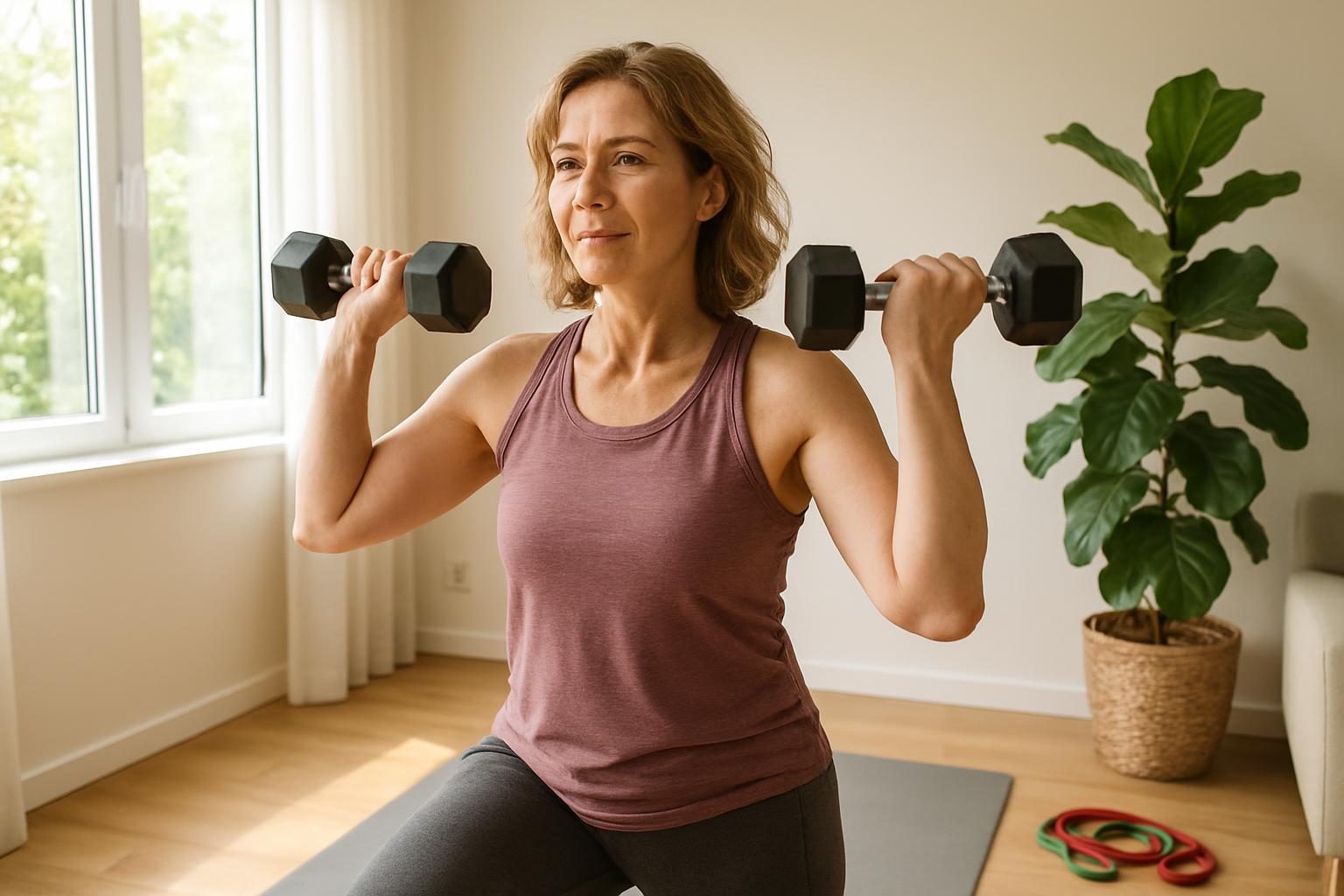
Use dumbbells, resistance bands or even filled water bottles. Do 2 to 3 sets of 8 to 12 reps of each move, resting about a minute between sets. These are common exercise patterns and a general template, not a personalized prescription.
| Exercise | Main muscles | Easy start |
|---|---|---|
| Goblet squat or chair squat | Quads, glutes | Sit to a chair and stand up, holding one weight at your chest |
| Glute bridge | Glutes, hamstrings | Lie on your back, knees bent, lift hips |
| One-arm dumbbell row | Upper back, biceps | Support one hand on a bench or chair |
| Incline push-up | Chest, shoulders, triceps | Hands on a counter or sturdy table |
| Romanian deadlift | Hamstrings, glutes | Hinge at the hips with light dumbbells |
| Plank or dead bug | Core | Hold 15 to 30 seconds or move slowly |
Warm up for five minutes first with walking or easy bodyweight moves. If you prefer low-impact work, our guide to wall Pilates for beginners can complement lifting, and St. Elizabeth notes that bodyweight exercises and Pilates count as strength-building options.
Strength training, menopause and bone density: what the evidence shows
Women often hear that lifting protects bones through menopause. The research is encouraging but not simple. A 2025 systematic review in Bone, covering only six studies, found that during perimenopause strength training did not improve areal bone mineral density or lean mass, while in early postmenopause strength training and walking benefited bone density and lean mass. The authors concluded it remains inconclusive which training method is best during the menopause transition.
Another review of 16 studies with 1,228 postmenopausal women found that resistance training lasting longer than six months led to increases in total and regional bone mineral density. The takeaway: consistency over months and years matters more than any one workout.
Protein, recovery and sleep
Harvard Health notes the standard protein recommendation is 0.8 grams per kilogram of body weight, and that people building muscle may do better with 1 to 1.2 grams per kilogram daily. The University of Missouri experts suggest at least 30 grams of protein per meal. If you have kidney disease or another condition, ask your clinician before raising protein. For easy protein-forward meals, see our anti-inflammatory breakfast recipes.
Muscle repairs between workouts, so sleep matters. Our guide to how much sleep you need by age is a good place to check your own target.
Heart and long-term benefits
Harvard Health cites a study finding that middle-aged adults who did just one to three strength workouts a week were 40% to 70% less likely to have a heart attack or stroke. That is observational research, so it shows an association rather than proof, but it fits the broader message: even a modest, regular habit pays off.
Check with your doctor before starting if you have heart disease, high blood pressure, osteoporosis, joint problems, pelvic floor symptoms or have been inactive for a long time. Stop and seek care for chest pain, dizziness, severe shortness of breath or sharp joint pain. See a clinician if you notice muscle weakness, trouble with daily tasks, falls or slow walking speed, which can signal that muscle loss is affecting your health.
Frequently asked questions
How often should a woman in her 40s lift weights?
Two or more days a week for all major muscle groups, per the Physical Activity Guidelines, with at least a day of rest between sessions for the same muscles.
Is it too late to start strength training at 40, 50 or beyond?
No. Experts quoted by the University of Missouri say consistent muscle-building activity can help reverse age-related changes and slow muscle loss.
Do I need a gym?
No. Hand weights, bands, household items and bodyweight exercises all count, according to St. Elizabeth Healthcare.
Will lifting make me bulky?
Two or three beginner-level sessions a week build strength gradually. If you have specific body-composition goals, a certified trainer can help you adjust sets, reps and nutrition.
How many reps and sets should a beginner do?
Two to three sets of 8 to 12 repetitions per exercise is a common starting point.
Sources
- PMC, Piercy et al., The Physical Activity Guidelines for Americans (2018)
- Harvard Health, A guide to combatting sarcopenia and preserving muscle mass as you get older
- University of Missouri Health Care, Worried about age-related muscle loss? 4 tips to prevent sarcopenia
- Bone, Whitman et al., Does exercising during peri- or early post-menopause prevent bone and muscle loss (2025)
- Purenovic-Ivanovic et al., The effect of resistance training on bone mineral density in postmenopausal women
Save this guide for later on Pinterest