Last updated:
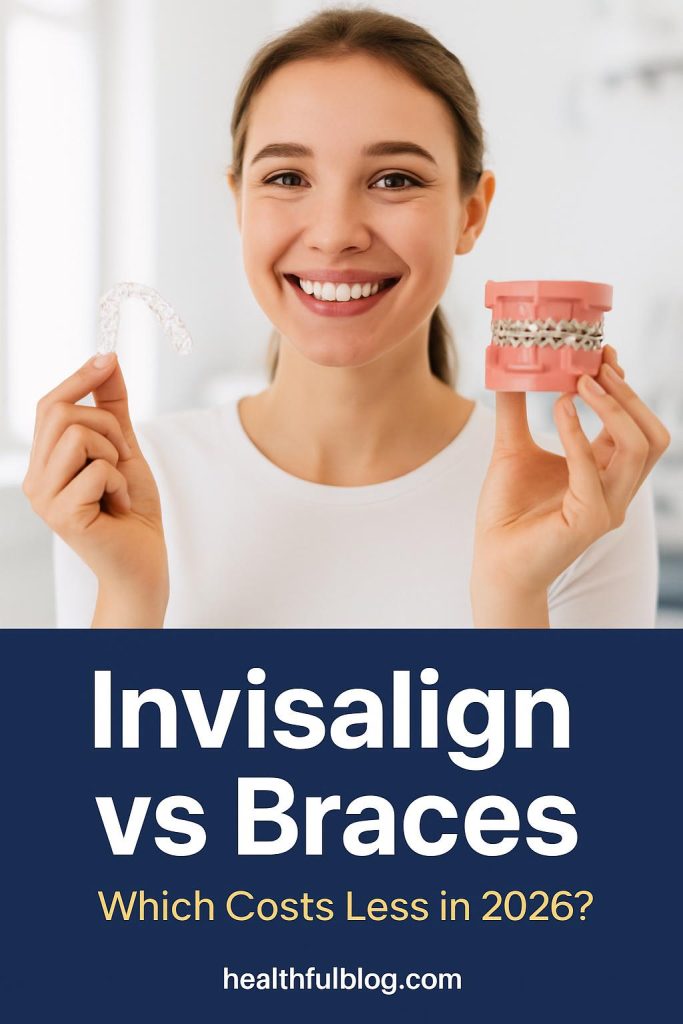
Straighter teeth are no longer a teenage rite of passage. Adults now make up a large share of orthodontic patients, and most of them face the same first question: should I get clear aligners like Invisalign or traditional braces, and which one will cost me less? The honest answer is that the price ranges overlap a lot. What really changes the bill is how complex your case is, how long treatment lasts and how disciplined you are. This guide breaks down real 2026 prices, what is included, how insurance and tax-free accounts apply, and how to choose without overpaying.
- Invisalign typically costs $3,000 to $8,000; metal braces usually run $3,000 to $7,000 and can reach $10,000 or more for severe cases.
- Clear aligners often finish in 12 to 18 months, but only if you wear them 20 to 22 hours a day.
- Braces handle complex bite problems more predictably and are more likely to be partly covered by dental insurance, especially for children.
- HSA and FSA dollars can be used for both options, which effectively cuts the price by your tax rate.
Invisalign vs braces cost at a glance
Here is how the two most common options compare on price and practical details. Figures are national ranges; your local quote may sit above or below them.
| Factor | Invisalign (clear aligners) | Traditional metal braces |
|---|---|---|
| Typical total cost | $3,000 to $8,000 | $3,000 to $7,000 (up to $10,000+ for severe cases) |
| Average treatment time | 12 to 18 months (sometimes as short as 6) | 12 to 24 months, longer for complex bites |
| Daily commitment | Wear 20 to 22 hours a day, remove to eat | Fixed in place, nothing to remember |
| Office visits | Every 6 to 10 weeks, often shorter | About every 4 to 8 weeks for adjustments |
| Food restrictions | None while aligners are out | Avoid hard, sticky and chewy foods |
| Best for | Mild to moderate crowding and spacing | All cases, including severe crowding and bite problems |
| Insurance coverage | Sometimes, under orthodontic benefits | More often, especially for children |
Price data from NewMouth, which draws on American Dental Association survey figures showing a typical range of roughly $4,200 to $6,600 for comprehensive orthodontic treatment.
What is included in the price
An orthodontic quote is usually a package price, and comparing two quotes only makes sense when you know what each one includes. Before you sign, ask whether these items are part of the total:
- Initial consultation and records. X-rays, photos and a digital scan. Many offices offer a free consultation, but records can cost a few hundred dollars on their own.
- All aligners or all adjustments. For Invisalign, ask how many refinement trays are included if your teeth do not track as planned. For braces, ask whether broken brackets are repaired at no charge.
- Retainers. Every patient needs a retainer after treatment. Some offices include the first set; others charge $100 to $500 per arch, and replacement retainers are almost always extra.
- Emergency visits. Poking wires and lost aligners happen. Know the policy before it does.
A quote that looks $1,000 cheaper can end up more expensive once refinements and retainers are added. Ask for the inclusions in writing.
Why Invisalign prices vary so much
Clear aligner pricing has a wide spread because the product comes in tiers. A short, limited treatment for minor crowding uses fewer trays and costs less than a comprehensive plan with unlimited refinements. Several factors push your price up or down:
- Case complexity. Mild spacing may need a few months of trays. Rotated teeth, deep bites and crossbites require more trays, attachments (small tooth-colored bumps bonded to the teeth) and sometimes rubber bands.
- Provider type. Orthodontists and general dentists can both offer clear aligners. An orthodontist has two to three extra years of specialty training, which matters most for complex cases.
- Location. Fees in large coastal cities tend to be higher than in smaller markets.
- Your compliance. Aligners only move teeth while they are in your mouth. Wearing them 16 hours instead of 22 can stall progress and add trays, time and sometimes cost.
The real cost of braces in 2026
Metal braces remain the workhorse of orthodontics. They are fixed to the teeth, so they work around the clock whether you remember them or not, and orthodontists can make precise adjustments at every visit. For many adults the price is similar to Invisalign. Variants change the math:
- Metal braces: the most common and usually the lowest-cost fixed option.
- Ceramic (clear) braces: tooth-colored brackets that are less noticeable, generally priced above metal.
- Lingual braces: bonded behind the teeth so they are nearly invisible; typically the most expensive option because each bracket is custom-made and adjustments take longer.
For severe crowding, significant bite correction or cases that combine orthodontics with jaw surgery, totals can climb well past $10,000. In those situations braces are often the more predictable tool, and the comparison is less about price than about what will actually work.
Does insurance cover Invisalign or braces?
Orthodontic coverage depends entirely on your plan. Many dental plans include an orthodontic benefit with a lifetime maximum, commonly between $1,000 and $3,000 per person. A few points to check with your insurer:
- Age limits. Many plans cover orthodontics only for dependents under 19. Adult orthodontic coverage exists but is less common.
- Treatment type. Some plans pay the same amount for aligners and braces; others treat aligners as cosmetic. Ask directly whether clear aligners qualify.
- Waiting periods. New plans may require you to be enrolled for 6 to 12 months before the orthodontic benefit applies.
- Payment schedule. Insurers usually pay the lifetime maximum in installments over the course of treatment, not in one lump sum.
Original Medicare does not cover orthodontics. If you are budgeting for other dental work later in life, our guide to how much dental implants cost explains what Medicare and private plans typically pay.
How to pay less without cutting corners
- Use pre-tax money. Orthodontic treatment is a qualified medical expense for Health Savings Accounts (HSA) and Flexible Spending Accounts (FSA). Paying with pre-tax dollars can save 20 to 35 percent depending on your tax bracket. If you have an FSA, schedule your contribution for the year treatment starts.
- Ask for in-house financing. Most orthodontists offer interest-free monthly plans over the length of treatment. That is usually a better deal than a medical credit card with deferred interest.
- Request a pay-in-full discount. Some offices take 5 to 10 percent off when you pay upfront.
- Get two or three consultations. They are often free. Comparing treatment plans also tells you whether your case is truly simple enough for aligners.
- Consider a dental school. University orthodontic programs often charge less, with residents supervised by experienced faculty. Treatment can take longer to start.
- Protect your retainer. Losing or breaking retainers is one of the most common hidden costs. Wear them as directed so you never pay twice for the same smile.
What about mail-order aligners?
At-home aligner companies advertise lower prices, often a few thousand dollars, by skipping most in-person visits. The trade-off is supervision. An orthodontist checks your gums, bone levels and bite before moving teeth and adjusts course when something goes off track. Moving teeth on unhealthy gums or untreated cavities can cause damage that costs more to fix than you saved. If you consider at-home aligners, at minimum get a dental exam and X-rays first, and make sure a licensed dentist or orthodontist reviews your case.
Which one should you choose?
Price is rarely the deciding factor, because the ranges overlap. Lifestyle and the type of correction you need usually decide it.
Invisalign may suit you if you have mild to moderate crowding or gaps, you want a nearly invisible option for work or social life, you do not want food restrictions and you are confident you will wear the trays almost all day.
Braces may suit you if you have a complex bite, significant rotations or crowding, you know you would forget or remove aligners, or your insurance pays more for traditional braces. Teens are also frequently steered toward braces because compliance is not an issue.
Confidence in your smile has a real impact on how you feel day to day. If you are also weighing other appearance-related procedures, our breakdown of hair transplant costs uses the same approach: total price, what is included and how to pay less.
Caring for your teeth during treatment
Whichever option you choose, orthodontic treatment makes oral hygiene more demanding. Food gets trapped around brackets, and aligners hold anything left on your teeth against the enamel for hours. Brush after meals, floss daily (floss threaders or a water flosser help with braces), and keep up regular cleanings with your dentist. A balanced diet supports healthy gums too; see our overview of the vitamins and minerals your body needs daily, including calcium and vitamin D.
Book an evaluation if you have jaw pain, clicking, difficulty chewing, teeth that are shifting, or crowding that makes cleaning hard. During treatment, call your provider promptly for a broken bracket or wire that cuts your cheek, an aligner that no longer fits, swelling, or pain that lasts more than a few days. Children should have a first orthodontic check by about age 7, as recommended by the American Association of Orthodontists.
Frequently asked questions
Is Invisalign cheaper than braces?
Not usually. For a similar case, the two often cost about the same. Invisalign can be cheaper for very mild cases that need a short treatment, while braces can be cheaper for complex cases that would require many aligner refinements.
Does Invisalign work faster than braces?
For simple cases, aligners can finish in 12 to 18 months and occasionally as quickly as 6 months. Complex movements are often faster and more predictable with braces. Your actual time depends heavily on how consistently you wear aligners.
Can adults get braces?
Yes. There is no upper age limit as long as your teeth and gums are healthy. Adult treatment can take slightly longer because bone is denser.
Can I use my HSA or FSA for Invisalign?
Yes. Orthodontic treatment to correct a dental problem is an eligible medical expense for HSA and FSA funds. Keep your receipts and treatment plan.
Do I need a retainer after Invisalign or braces?
Yes. Teeth naturally drift back toward their old position. Most orthodontists recommend wearing a retainer full time at first and then at night, often indefinitely.
Sources
- NewMouth, Invisalign vs. Braces: Cost, Pros and Cons
- American Association of Orthodontists, When Should My Child See an Orthodontist?
- IRS Publication 502, Medical and Dental Expenses
- Medicare.gov, Dental Services
Save this guide for later on Pinterest