Last updated:
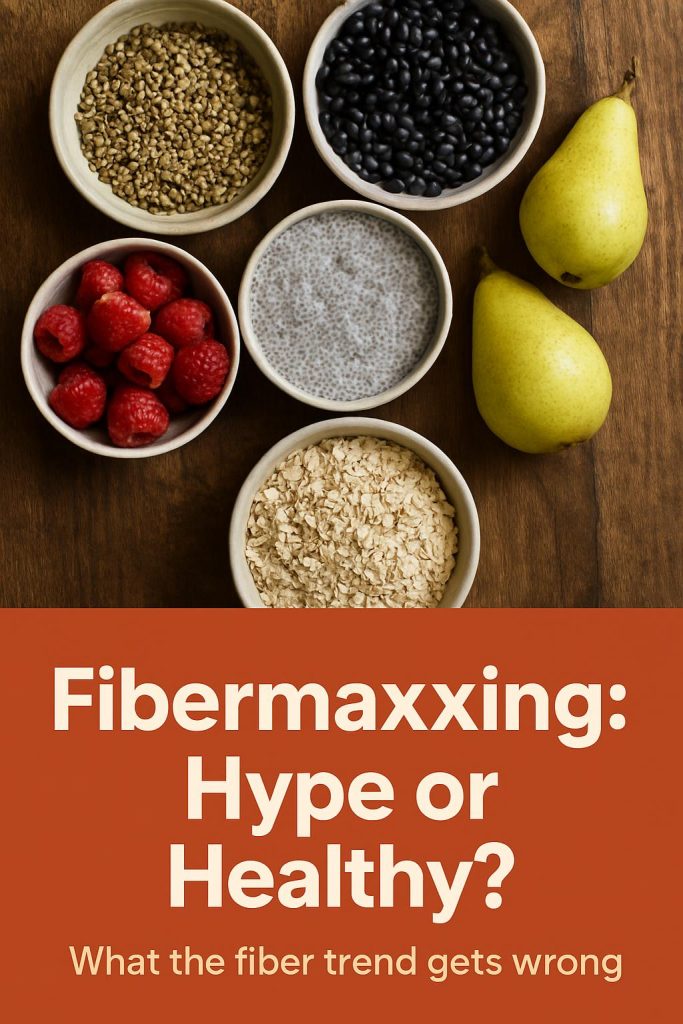
Scroll through TikTok or Instagram for a few minutes and you may run into “fibermaxxing”: people loading their plates with chia seeds, beans, berries and bran, and tallying up how many grams of fiber they can hit in a day. Unlike many viral diet trends, this one points at a real gap in the American diet. But more is not always better, and going from very little fiber to a lot overnight can backfire. Here is what the evidence actually says.
- Fibermaxxing is a social media trend built around deliberately eating more fiber, mostly from plants like beans, whole grains, fruit, vegetables, nuts and seeds.
- Most adults need roughly 22 to 34 grams a day, depending on age and sex, and very few Americans reach that amount.
- Getting to your target has well-documented benefits; there is no good evidence that going far beyond it adds more.
- Increase slowly over a few weeks, drink enough fluids, and check with a clinician first if you have a digestive condition or take daily medications.
What is fibermaxxing?
Fibermaxxing is a TikTok-born trend in which people intentionally raise their daily fiber intake to meet or exceed recommended amounts, usually with foods like chia seeds, fruit, vegetables and nuts, according to reporting that interviewed registered dietitian Mia Syn. Some creators share high-fiber recipes; others post fiber “scores” or viral loaves nicknamed “poop bread,” as the University of Colorado Anschutz Medical Campus noted.
The name borrows “maxxing” slang, implying pushing something to the limit. That framing, not the food choices, is the part worth questioning.
The claim vs. the evidence
The trend’s underlying claim is that most people eat too little fiber and would feel and function better with more. That part holds up.
Fewer than 5% of Americans meet the recommended daily fiber intake, according to CU Anschutz. Harvard’s Nutrition Source says most Americans eat only about 15 grams a day, well below the 25 to 35 grams it recommends. A registered dietitian quoted by CU Anschutz, Bonnie Jortberg, PhD, RDN, described intake as “abysmal” and called the renewed attention to fiber “a good thing.”
Where the trend overreaches is the idea that more is always better. Jortberg also pointed out that there is no data showing that very large amounts are more beneficial than simply getting what is recommended.
How much fiber do you actually need?
US recommendations vary slightly by source, but they land in a similar range. The National Institute of Diabetes and Digestive and Kidney Diseases says adults should get 22 to 34 grams of fiber a day, depending on age and sex, based on the Dietary Guidelines for Americans. The newer 2025-2030 Dietary Guidelines, released January 7, 2026, continue to point to fruits, vegetables, whole grains and legumes as excellent fiber sources, as summarized by Oklahoma State University Extension.
| Group | Dietary Guidelines-based target | National Academy of Medicine target |
|---|---|---|
| Women, 19-30 | 28 g/day | 25 g/day (age 50 or younger) |
| Men, 19-30 | 34 g/day | 38 g/day (age 50 or younger) |
| Women, 51+ | 22 g/day | 21 g/day (over 50) |
| Men, 51+ | 28 g/day | 30 g/day (over 50) |
Sources: Dietary Guidelines figures as reported by CU Anschutz; National Academy of Medicine figures as listed by Mayo Clinic.
The practical takeaway: for most adults, somewhere in the mid-20s to mid-30s in grams is the goal. If you currently eat around 15 grams, you are not short by a little. You may need to roughly double your intake.
Benefits of getting enough fiber
The benefits that drive the trend are real when you reach recommended amounts. According to Mayo Clinic, fiber:
- Supports regularity. It increases the weight and size of stool and softens it, which lowers the chance of constipation.
- Helps heart health. Soluble fiber, found in oats, beans and some fruits, may help lower cholesterol.
- Helps steady blood sugar. Fiber can slow the absorption of sugar.
- Keeps you full. High-fiber foods tend to be more filling than low-fiber foods.
Mayo Clinic also notes that getting enough fiber is linked with a lower risk of dying from any health condition. CU Anschutz lists reduced risk of colorectal cancer, type 2 diabetes and cardiovascular disease among the associations seen in research. Much of this evidence is observational, so it shows a link rather than proof of cause.
If you want ideas for where to start, our high-fiber foods list breaks down easy swaps by category.
Risks of too much fiber, too fast
For most healthy people, fibermaxxing is fairly low risk, but the jump is where trouble starts. Raising fiber too quickly can cause bloating or excess gas, stomach cramps, loose stools or even constipation, according to Baylor Scott & White Health.
Very high intakes bring their own issues. CU Anschutz notes that amounts in the 50 to 70+ gram range can cause bloating, gas and diarrhea and may interfere with nutrient absorption. Reporting on the trend notes that excessive fiber may affect absorption of minerals such as calcium.
A few other cautions:
- Medications. Fiber can affect how some drugs are absorbed. Baylor Scott & White specifically mentions thyroid medications and certain antibiotics.
- Digestive conditions. People with IBS, Crohn’s disease or diverticulitis should talk with their doctor before making big changes.
If you are already dealing with frequent bloating, our guide to bloating causes and relief can help you sort out what might be going on.
How to increase fiber safely
The goal is a steady ramp, not a one-day challenge. Mayo Clinic advises adding fiber slowly over a few weeks and drinking plenty of water, since fiber works best when it absorbs water. A practical plan:
- Know your starting point. Track a few typical days first.
- Add about one serving at a time. Dietitian Mia Syn suggests adding one more serving of a high-fiber food per day for a week, then repeating. Baylor Scott & White suggests roughly 5 grams more per week.
- Spread it out. Include some fiber at each meal rather than loading it all into one smoothie.
- Drink with it. Increase fluids as you increase fiber.
- Favor whole foods. Harvard notes supplements such as psyllium can help if food alone falls short, but are not meant to completely replace high-fiber foods.
Easy fiber sources to rotate in
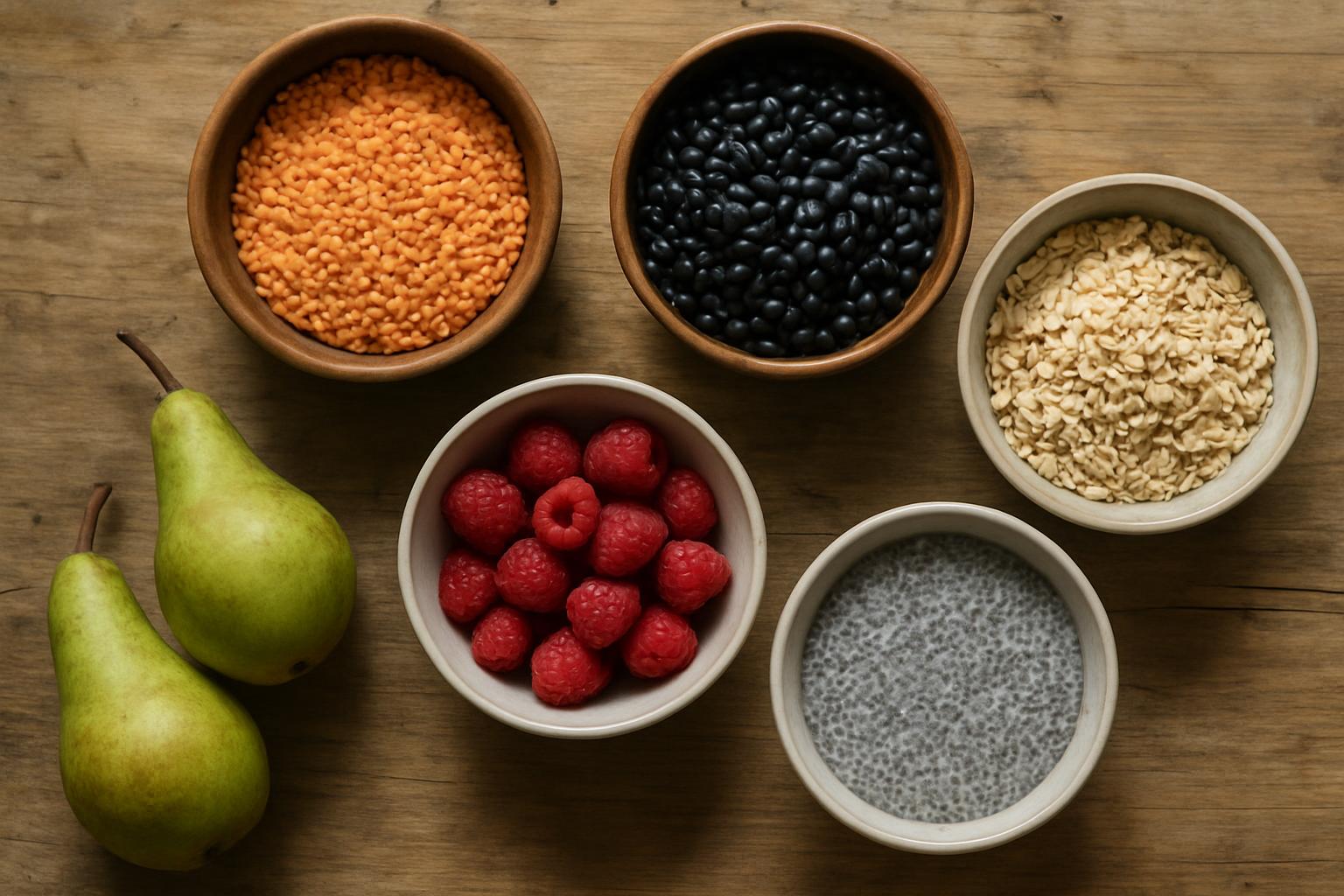
Per Mayo Clinic’s high-fiber foods chart:
| Food | Serving | Fiber |
|---|---|---|
| Lentils, boiled | 1 cup | 15.5 g |
| Black beans, boiled | 1 cup | 15 g |
| Chia seeds | 1 oz | 10 g |
| Green peas, boiled | 1 cup | 9 g |
| Raspberries | 1 cup | 8 g |
| Whole-wheat spaghetti, cooked | 1 cup | 6 g |
| Pear | 1 medium | 5.5 g |
| Oatmeal, instant, cooked | 1 cup | 4 g |
A cup of lentils plus an ounce of chia already tops 25 grams, a lot for a gut used to 12. Chia in particular absorbs a lot of liquid; see our chia seed water guide for how to prepare it comfortably.
The verdict
Mostly true, with an asterisk. The heart of fibermaxxing, eating more beans, whole grains, fruit, vegetables, nuts and seeds, is solid advice for the vast majority of Americans. The “maxxing” part is the weak spot. The evidence supports reaching the recommended range, not racing past it, and a sudden jump is the most common way people end up bloated and uncomfortable. Aim for your target, get there over a few weeks, and let food do most of the work.
This article is for general information and is not a substitute for medical advice. Talk with your doctor or a registered dietitian before making large diet changes if you have IBS, Crohn’s disease, diverticulitis or another digestive condition, or if you take daily medications such as thyroid medicine. Seek care promptly for severe or persistent abdominal pain, vomiting, blood in your stool, unexplained weight loss, or a change in bowel habits that lasts more than a few weeks.
Frequently asked questions
Is fibermaxxing safe?
For most healthy adults who increase fiber gradually and drink enough fluids, it is generally safe. Problems usually come from adding too much too fast or going far beyond recommended amounts.
How much fiber is too much?
There is no single official upper limit, but experts quoted by CU Anschutz note that 50 to 70+ grams a day can cause digestive symptoms and may affect nutrient absorption, with no proven extra benefit.
Should I use fiber supplements to fibermaxx?
Supplements like psyllium can help fill a gap, but Harvard notes they are not meant to replace high-fiber foods, which also provide vitamins, minerals and other plant compounds. Ask your pharmacist about timing if you take medications.
Why do I feel bloated after eating more fiber?
Your gut bacteria ferment some types of fiber, which produces gas. A slower ramp-up over a few weeks usually gives your system time to adjust.
Can fibermaxxing help with weight loss?
High-fiber foods tend to be more filling, which may help with appetite, but fiber is not a weight-loss treatment on its own, and results vary widely from person to person.
Sources
- University of Colorado Anschutz Medical Campus, Can a “Fibermaxxing” Social Media Trend Reverse America’s Abysmal Intake?
- Mayo Clinic, Dietary fiber: Essential for a healthy diet
- NIDDK, Eating, Diet, & Nutrition for Constipation
- Harvard T.H. Chan School of Public Health, The Nutrition Source: Fiber
- Baylor Scott & White Health, Fibermaxxing: Is this high-fiber trend actually healthy?
Save this guide for later on Pinterest