Last updated:
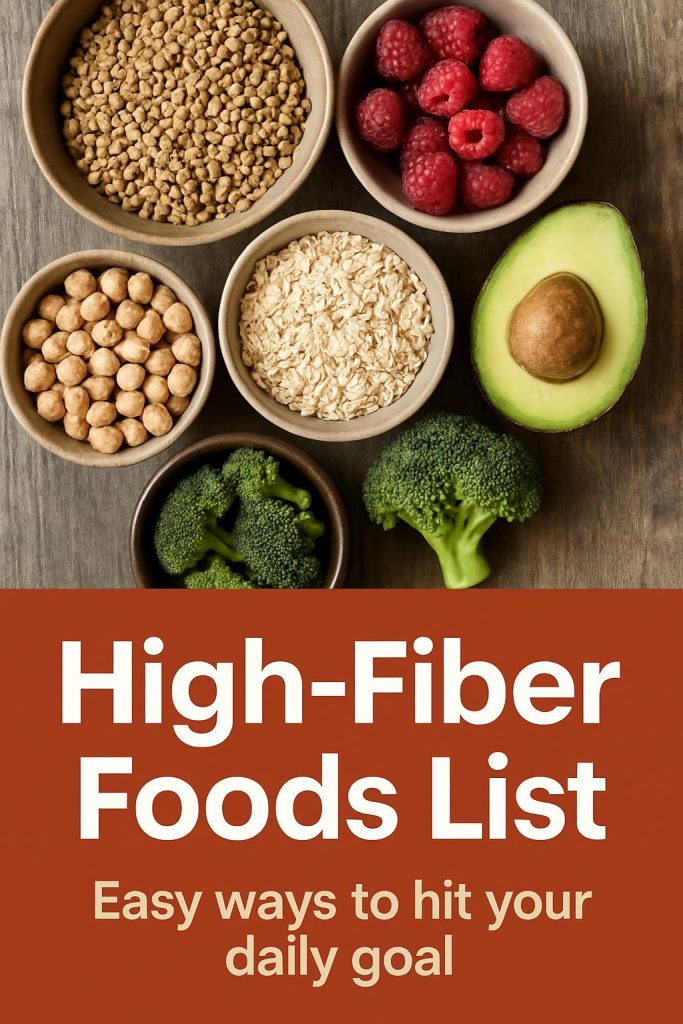
Fiber is one of those nutrients almost everyone agrees is good for you, yet very few people actually eat enough of it. An analysis of 2013-2018 national survey data shared by the American Society for Nutrition estimated that only about 5% of US men and 9% of US women meet fiber recommendations. The good news: closing that gap rarely takes exotic ingredients. A smart high-fiber foods list, a few swaps, and a realistic plan for one day of eating can get you most of the way there.
- Most adults need roughly 21 to 38 grams of fiber a day, depending on age and sex, or about 14 grams per 1,000 calories.
- Beans, lentils and split peas are the fiber heavyweights, with 13 to 16 grams per cooked cup.
- Spreading fiber across meals and snacks is easier than trying to load it into one sitting.
- Increase fiber gradually over several weeks and drink enough fluids to limit gas and bloating.
How much fiber do you actually need?
According to the Mayo Clinic’s summary of National Academy of Medicine recommendations, daily targets look like this: women under 50 need about 25 grams, women 50 and older about 21 grams, men under 50 about 38 grams, and men 50 and older about 30 grams.
The Dietary Guidelines for Americans frame it another way. As Mayo Clinic explains, the guidelines suggest 14 grams of fiber for every 1,000 calories for people age 2 and older. On a 2,000-calorie day, that works out to about 28 grams.
Compare that with reality. Harvard’s Nutrition Source notes that most Americans get only about 15 grams a day, roughly half of what they need.
Soluble vs. insoluble fiber: why you want both
Fiber comes in two broad types, and most plant foods contain a mix.
- Soluble fiber dissolves in water and forms a gel. Harvard notes it can help lower blood glucose and cholesterol. Good sources include oats, chia seeds, beans, lentils, apples and blueberries.
- Insoluble fiber does not dissolve and adds bulk to stool, which supports regularity. You find it in whole wheat, brown rice, quinoa, leafy greens, nuts and the edible skins of fruit.
You don’t need to track these separately. Eating a variety of whole plant foods covers both.
High-fiber foods list by category
The figures below come from Mayo Clinic’s high-fiber foods chart. Values are rounded.
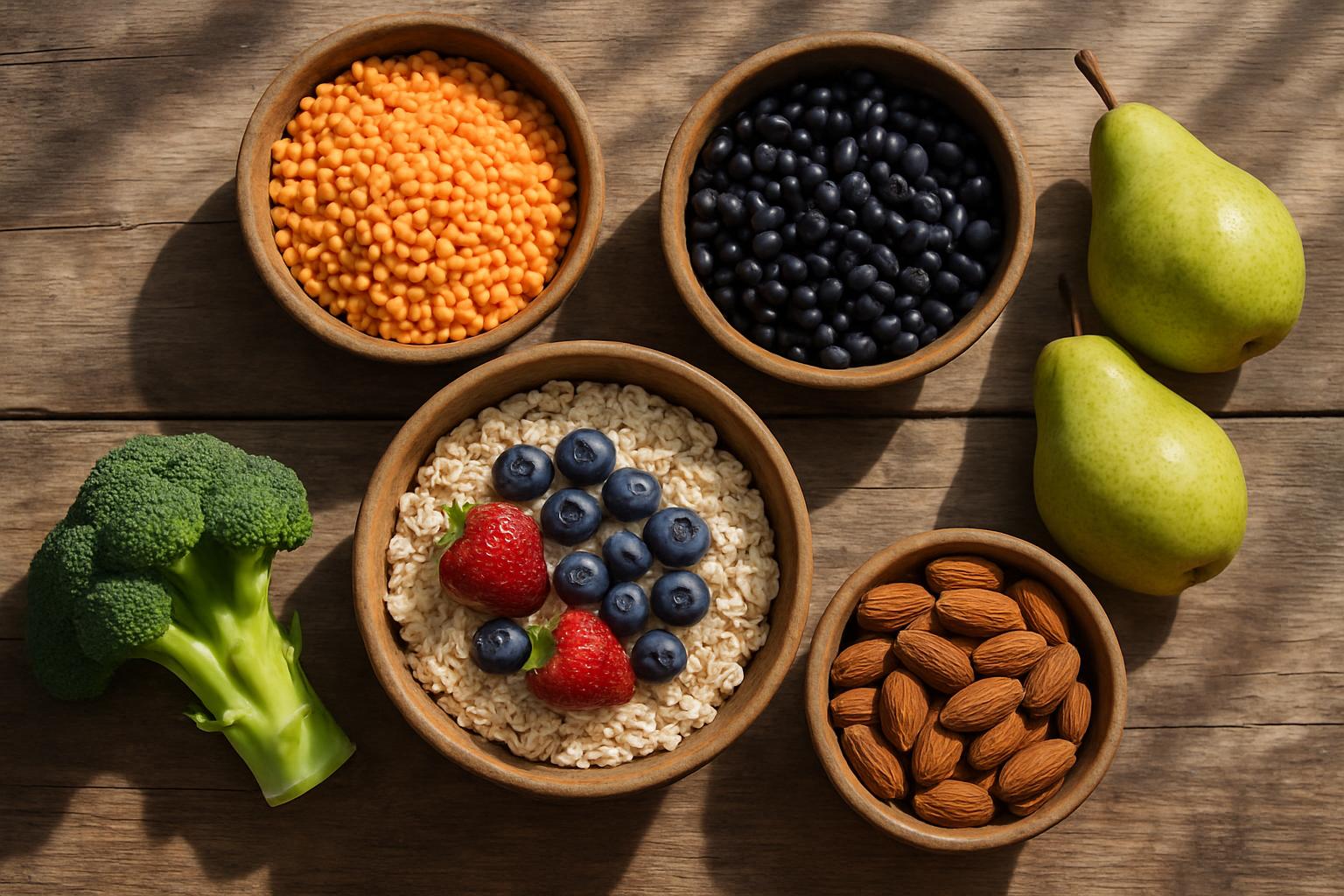
Legumes, nuts and seeds
- Split peas, boiled, 1 cup: 16 g
- Lentils, boiled, 1 cup: 15.5 g
- Black beans, boiled, 1 cup: 15 g
- Canned white beans (cannellini, navy, Great Northern), 1 cup: 13 g
- Chia seeds, 1 ounce: 10 g
- Almonds, 1 ounce (about 23 nuts): 3.5 g
Vegetables
- Green peas, boiled, 1 cup: 9 g
- Broccoli, boiled, 1 cup chopped: 5 g
- Brussels sprouts, boiled, 1 cup: 4.5 g
- Baked potato with skin, 1 medium: 4 g
Fruits
- Raspberries, 1 cup: 8 g
- Pear, 1 medium: 5.5 g
- Apple with skin, 1 medium: 4.5 g
- Banana, orange or 1 cup strawberries: about 3 g each
Grains
- Whole-wheat spaghetti, cooked, 1 cup: 6 g
- Pearled barley, cooked, 1 cup: 6 g
- Quinoa, cooked, 1 cup: 5 g
- Instant oatmeal, cooked, 1 cup: 4 g
- Air-popped popcorn, 3 cups: 3.5 g
- Brown rice, cooked, 1 cup: 3.5 g
Notice the pattern: a single cup of beans or lentils delivers more fiber than most people eat at breakfast and lunch combined. If you only change one habit, adding legumes a few times a week is the highest-impact move.
A sample high-fiber day
Here’s what roughly 33 grams of fiber can look like using everyday foods. Fiber values are based on the Mayo Clinic chart above, adjusted for portion size.
| Meal | What to eat | Approx. fiber |
|---|---|---|
| Breakfast | 1 cup cooked oatmeal topped with 1 cup sliced strawberries | 7 g |
| Morning snack | 1 medium apple, skin on | 4.5 g |
| Lunch | Lentil soup made with 1/2 cup cooked lentils, plus 1 slice whole-wheat bread | 10 g |
| Afternoon snack | 1 ounce almonds (about 23) | 3.5 g |
| Dinner | Stir-fry with 1 cup broccoli over 1 cup brown rice | 8.5 g |
| Total | About 33.5 g |
Want recipes that fit right in? Try our gut-healthy overnight oats for a make-ahead breakfast, or a pot of turmeric lentil soup for several fiber-packed lunches.
If you currently eat closer to 15 grams, don’t jump straight to this menu. Start with one change, such as the oatmeal breakfast, and add another every week or so.
Easy swaps that add fiber without a full diet overhaul
Small substitutions add up quickly. Mayo Clinic and Harvard both recommend strategies like these:
- Choose whole fruit over juice. An apple with its skin has fiber; most of it is lost in juice.
- Make at least half your grains whole. Swap white pasta for whole-wheat and white rice for brown rice or barley.
- Check cereal labels. Mayo suggests breakfast cereals with 5 or more grams per serving.
- Replace meat with beans two or three times a week, as Harvard suggests. Chili, tacos and grain bowls all work well.
- Sprinkle seeds. A spoonful of chia or ground flaxseed stirs easily into yogurt or oatmeal.
- Snack on popcorn, nuts or raw vegetables instead of chips or crackers.
How to increase fiber without the bloat
The most common complaint when people boost fiber is gas. Mayo Clinic advises adding fiber gradually over a few weeks so the natural bacteria in your digestive system can adjust. It also notes that fiber works best when it absorbs water, so drink enough fluids throughout the day.
A practical approach:
- Track a typical day to find your starting point.
- Add about one high-fiber food every few days.
- Pair each fiber increase with a glass of water.
- If beans bother you, start with smaller portions and build up slowly.
If irregularity is what’s pushing you to eat more fiber, our article on how constipation can affect your well-being covers the bigger picture.
Food first, supplements second
Fiber supplements can help some people, but whole foods bring vitamins, minerals and other plant compounds that powders don’t. Mayo Clinic notes that soluble fiber from beans, oats and flaxseed may help limit cholesterol absorption, and that higher-fiber diets are linked with better blood sugar control and lower risk of heart disease. Harvard reports associations between higher fiber intake and lower risk of conditions including diverticulitis and type 2 diabetes.
If you have trouble getting enough from food, ask your doctor or a registered dietitian whether a supplement makes sense for you, since some can interact with medications.
Talk with a healthcare professional before making big fiber changes if you have a digestive condition such as inflammatory bowel disease, a history of bowel obstruction or narrowing, or you’ve been told to follow a low-fiber diet. Also check in if you notice ongoing changes in bowel habits, blood in your stool, unexplained weight loss or persistent abdominal pain.
Frequently asked questions
What food has the most fiber per serving?
Among common foods, legumes lead the pack. A cup of boiled split peas has about 16 grams, and a cup of lentils or black beans has about 15 grams, according to Mayo Clinic.
Is it possible to eat too much fiber?
Increasing fiber too quickly can cause gas, bloating and cramping. Raising intake gradually and drinking enough fluids usually helps your body adjust.
Do I need to count fiber grams every day?
Not usually. Tracking for a few days can show you where you stand, but building meals around whole grains, beans, fruits and vegetables generally gets you close.
Are fruit smoothies a good fiber source?
Blended whole fruit keeps its fiber, unlike juice. Adding oats, chia seeds or spinach can raise the fiber count further.
Sources
- Mayo Clinic, Chart of high-fiber foods
- Mayo Clinic, Dietary fiber: Essential for a healthy diet
- Harvard T.H. Chan School of Public Health, The Nutrition Source: Fiber
- American Society for Nutrition, Just 7% of adults meet fiber recommendations
Save this guide for later on Pinterest