Last updated:
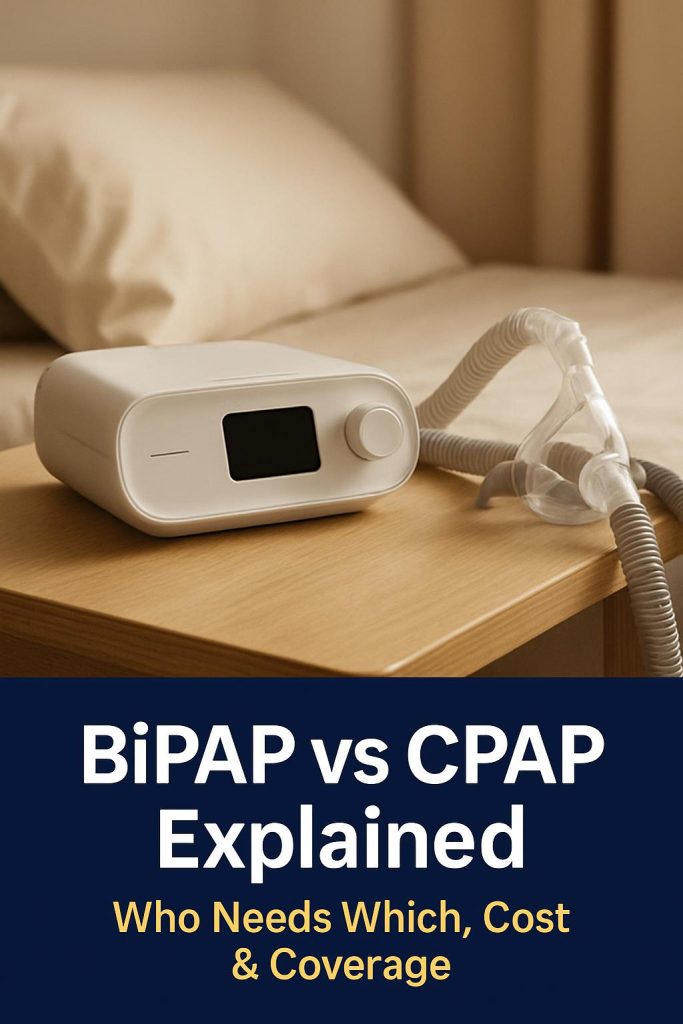
If you have been diagnosed with sleep apnea, chances are your first prescription was for a CPAP machine. But you may have heard about BiPAP too, and wondered whether it is more comfortable, more advanced, or simply more expensive. The short answer: both machines push air through a mask to keep your airway open, but they do it differently, they serve different patients, and insurance treats them very differently.
- CPAP delivers one steady pressure; BiPAP delivers a higher pressure when you breathe in and a lower one when you breathe out.
- CPAP is the standard first treatment for obstructive sleep apnea. BiPAP is usually for people who can’t tolerate CPAP or who have certain lung, heart or breathing-control problems.
- BiPAP machines cost roughly two to three times more than CPAP machines, and insurers, including Medicare, usually want proof that CPAP didn’t work first.
- Never switch devices or change pressure settings on your own; that decision belongs to your sleep team.
How CPAP works
CPAP stands for continuous positive airway pressure. The National Heart, Lung, and Blood Institute describes it as a machine that uses mild air pressure to keep breathing airways open while you sleep. A motor pushes air through tubing and a mask, and that gentle pressure acts like a splint that stops the soft tissues of the throat from collapsing.
The key word is “continuous.” According to the Sleep Foundation, a CPAP delivers one fixed pressure, typically somewhere between 4 and 20 cm H2O, whether you are inhaling or exhaling. For most people with obstructive sleep apnea (OSA), that single setting is enough.
A close relative, the auto-adjusting machine (APAP), shifts pressure through the night within a range your clinician sets. It is still a single-pressure device at any given moment, so it is not the same as BiPAP.
How BiPAP works
BiPAP, or bilevel positive airway pressure, uses two settings. Cleveland Clinic explains that the machine uses “a higher air pressure when you’re inhaling and a lower one when you’re exhaling.” The inhale setting is called IPAP and the exhale setting EPAP.
That lower exhale pressure is the main comfort advantage: you are not breathing out against the same push of air. The Sleep Foundation notes BiPAP machines also reach higher pressures, up to about 30 cm H2O.
BiPAP is also widely used in hospitals. Cleveland Clinic describes it as a step between breathing on your own and being put on a ventilator, for people who need support but can still breathe independently.
BiPAP vs CPAP at a glance
| Feature | CPAP | BiPAP |
|---|---|---|
| Pressure settings | One fixed pressure | Two: higher on inhale, lower on exhale |
| Typical pressure range | About 4-20 cm H2O | About 4-30 cm H2O |
| Main use | First-line treatment for obstructive sleep apnea | CPAP intolerance, high pressure needs, central apnea, COPD, some heart and neuromuscular conditions |
| Typical machine price | About $500-$1,000 | About $1,700-$3,000 |
| Insurance coverage | Usually covered with a sleep apnea diagnosis | Usually covered only if CPAP fails or isn’t suitable |
Price ranges from the Sleep Foundation, accessed October 2026. Your actual cost depends on the model, supplier and insurance.
Who usually needs CPAP
CPAP is the default for obstructive sleep apnea, the most common form, where the airway physically collapses during sleep. The Sleep Foundation lists moderate to severe OSA as CPAP’s main use, especially for people who adapt to steady airflow without trouble exhaling.
Benefits can show up quickly. NHLBI notes that people often sleep better and snore less soon after starting, and that long-term use can help manage high blood pressure, lower stroke risk and improve memory and thinking. If you are still at the stage of wondering whether you have apnea at all, our guide to sleep apnea signs and treatment walks through the symptoms and the testing process.
Who may need BiPAP instead
BiPAP is not an “upgrade” everyone should want. It is a tool for specific situations. Based on the Sleep Foundation and Cleveland Clinic, your clinician may consider it if you:
- Struggle to exhale against CPAP pressure, even after trying mask changes and ramp settings
- Need high pressures to keep your airway open
- Swallow air on CPAP (aerophagia), causing bloating
- Have central sleep apnea, where the brain doesn’t consistently signal breathing
- Have COPD, heart failure, a neuromuscular condition, or carbon dioxide buildup in the blood (hypercapnic respiratory failure)
The Sleep Foundation stresses that any switch between devices should be made with your health care team. Pressure settings for BiPAP are usually set during a sleep study titration, so a new machine may mean another test. You can read more about that in our sleep study cost guide.
Side effects and comfort issues
Both machines share the same everyday complaints. NHLBI lists congestion, runny nose, dry mouth, nosebleeds and mask irritation as possible CPAP side effects, and advises stopping and calling your provider if you develop stomach discomfort or bloating.
BiPAP carries similar mask-related problems, including claustrophobia and discomfort. In hospital settings, Cleveland Clinic notes rarer risks such as lung injury from excess pressure, low blood pressure and aspiration pneumonia.
Before assuming you need BiPAP, it is worth troubleshooting CPAP: a different mask style, heated humidification, a ramp feature or exhalation relief settings may solve the problem. Your sleep clinic or equipment supplier can help adjust these.
Cost and insurance: what to expect
Machine price is only part of the picture. You will also need masks, cushions, tubing and filters replaced on a schedule. The Sleep Foundation puts typical CPAP machines at about $500 to $1,000 and BiPAP machines at about $1,700 to $3,000.
Coverage follows the same logic as the medicine. Most insurance plans cover CPAP for diagnosed sleep apnea, while BiPAP coverage is narrower and usually requires documentation that CPAP failed or isn’t appropriate.
Medicare rules for CPAP
Medicare Part B covers a 12-week trial of CPAP for people diagnosed with obstructive sleep apnea. After the Part B deductible, you pay 20% of the Medicare-approved amount for the rental and supplies. Medicare rents the machine for 13 months, after which you own it. To keep coverage after the trial, CMS guidance says you generally need to show use of 4 or more hours per night on 70% of nights during a consecutive 30-day period in the first three months, plus an in-person follow-up visit.
Medicare rules for BiPAP
For obstructive sleep apnea, Medicare covers a bilevel device without a backup rate when a CPAP has been “tried and proven ineffective” during a trial at home or in a facility. Bilevel devices used for other conditions follow different rules, so ask your supplier what documentation your plan needs. For a deeper look at out-of-pocket costs, see our article on CPAP machine cost with Medicare.
Talk to your sleep specialist if you still feel exhausted, snore loudly or wake gasping despite using your machine, if you can’t tolerate the pressure, or if your machine data shows frequent leaks. Seek prompt care for chest pain, severe shortness of breath, new confusion or persistent bloating and stomach pain while using any PAP device.
Frequently asked questions
Is BiPAP better than CPAP?
Not in general. CPAP works well for most people with obstructive sleep apnea. BiPAP is better only for people with specific needs, such as trouble exhaling, very high pressure requirements or certain lung and neuromuscular conditions.
Can I buy a BiPAP without a prescription?
No. In the US, both CPAP and BiPAP machines are prescription devices, and your settings should come from your clinician, usually based on a sleep study.
Will insurance pay for BiPAP if I just find CPAP uncomfortable?
Usually not on comfort alone. Insurers, including Medicare, typically want documentation that CPAP was tried and didn’t work, or that a medical condition makes BiPAP necessary.
Is BiPAP the same as a ventilator?
No. BiPAP is a noninvasive device that works through a mask while you breathe on your own. Cleveland Clinic describes it as a bridge between independent breathing and invasive ventilation.
Are there alternatives if I can’t use either machine?
Yes. Oral appliances, positional therapy and surgery are options for some people, including an implanted nerve stimulator. Ask your sleep specialist which ones fit your diagnosis.
Sources
- Sleep Foundation, CPAP vs. BiPAP
- Cleveland Clinic, BiPAP
- NHLBI, CPAP
- Medicare.gov, Continuous positive airway pressure (CPAP) devices
- CMS, Positive Airway Pressure (PAP) Devices: Complying with Documentation and Coverage Requirements
Save this guide for later on Pinterest