Last updated:
If you are missing several teeth, or all of them, the choice usually comes down to dentures or dental implants. Dentures cost far less up front. Implants feel closer to natural teeth and can last decades. Once you add up the lifetime costs, the gap is not always as wide as the first quote makes it look.
This guide compares dentures and implants on cost, comfort, lifespan and insurance, using national fee data and guidance from dental organizations, so you can go into a consultation with realistic numbers.
- A conventional denture averages about $2,085 per arch nationally. A single implant’s surgical placement averages about $3,075, before the abutment and crown are added.
- Implants are anchored in the jawbone and help preserve it. Dentures rest on the gums, and the bone underneath slowly shrinks.
- Dentures usually last 5 to 10 years and need relines every 1 to 2 years. Implants can last a lifetime, although the teeth attached to them wear out and get replaced.
- Original Medicare does not cover dentures or implants. Private plans typically pay about 50% of major work, up to a low annual maximum.
Dentures vs implants at a glance
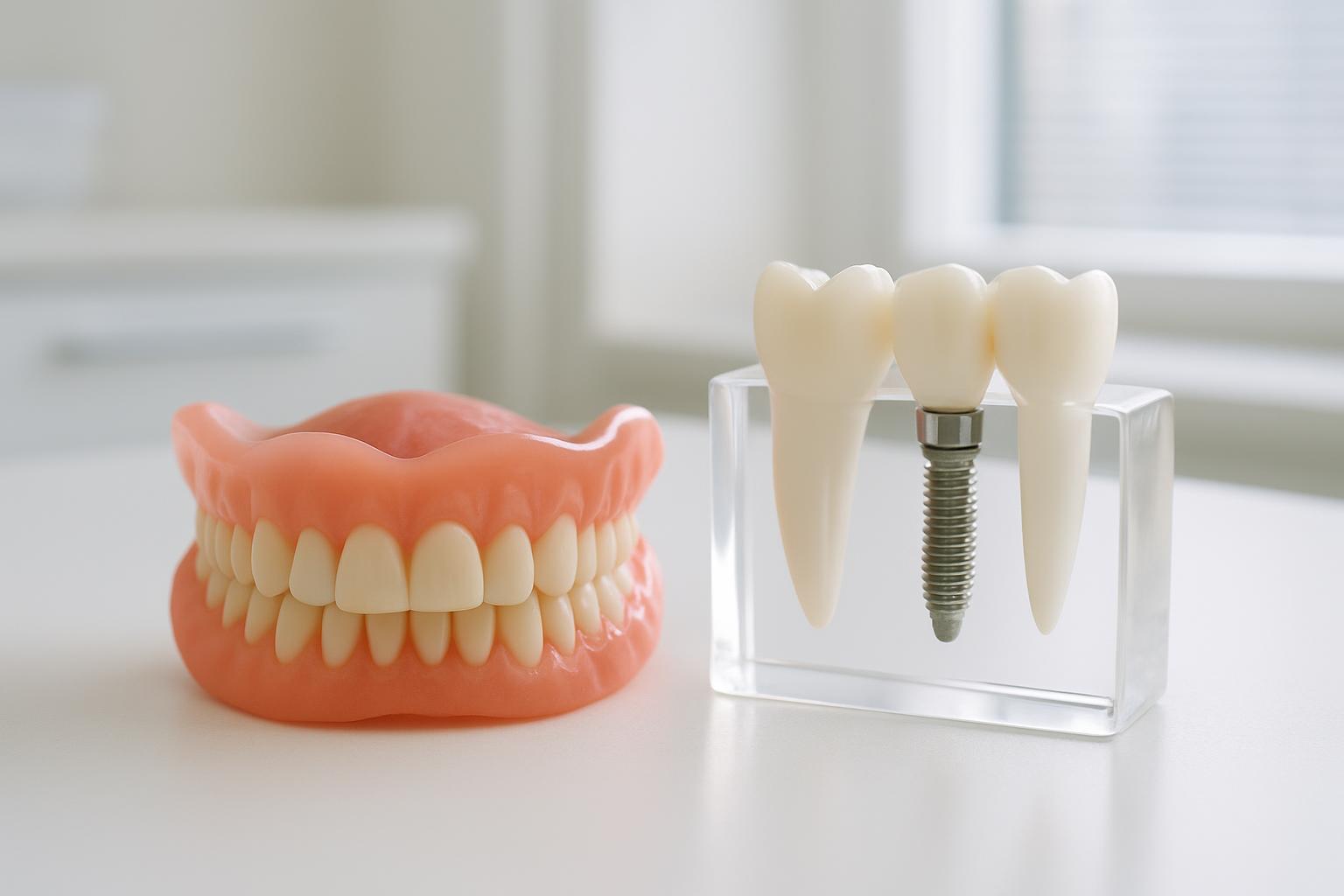
A conventional denture is a removable set of acrylic teeth on a gum-colored base. It stays in place by suction against the gums, sometimes helped by adhesive. A dental implant is a titanium post placed in the jawbone. The bone fuses to it over several months, and then a crown, bridge or denture is attached on top, as the ADA’s MouthHealthy describes.
The two can also be combined. Implant-retained “snap-in” dentures and fixed full-arch bridges such as All-on-4 fall between the two options in both price and stability.
| Factor | Conventional dentures | Dental implants |
|---|---|---|
| Typical cost | $1,360-$3,565 per denture (avg. $2,085) | $2,005-$5,255 for implant placement alone (avg. $3,075); about $3,000-$5,600 per tooth all-in |
| Lifespan | 5-10 years; relines every 1-2 years | Implant can last a lifetime; crown about 15 years |
| Stability | Can shift or slip when talking or chewing | Fixed in bone; doesn’t move |
| Jawbone | Bone shrinks over time | Helps preserve bone |
| Surgery | None, apart from any extractions | Required; 3-9 months of healing |
| Insurance | Often covered at about 50% after the deductible | Covered by some plans, excluded by others |
Sources: Pearl Dental Costs and Pearl implant data (ADA fee survey data, updated May 2026), NewMouth (May 2026), and Cleveland Clinic.
Upfront cost: what you’ll actually pay
Dentures
Pearl’s national data, based on ADA fee surveys, puts a complete or partial denture at $1,360 to $3,565, with a population-weighted average of $2,085. Replacing both upper and lower arches costs roughly twice as much as one arch. Immediate dentures, which are placed the same day your teeth are removed, often cost more over time because they need relines as your gums heal.
Implants
Implant quotes can be misleading. Pearl’s $3,075 national average (range $2,005 to $5,255) covers only the surgical placement of the post. The abutment (connector), the crown and any bone graft are usually billed separately. NewMouth’s 2026 estimate for a complete single implant, including the abutment and crown, is $3,000 to $5,600 per tooth. For a full guide to the parts and fees, see our breakdown of dental implant cost.
Replacing a whole arch with individual implants is rarely practical. Most full-arch patients choose either implant-retained dentures (about $2,000 to $13,300 per arch according to NewMouth) or a fixed full-arch bridge. Our All-on-4 cost guide covers that route in detail.
Lifetime cost: the math most people skip
The upfront gap shrinks once you add maintenance. Cleveland Clinic says the average denture lasts seven to 10 years and recommends a reline every one to two years, or whenever the fit changes. Pearl’s data suggests denture teeth wear out after about 5 to 7 years. Over 20 or 30 years, you can expect to buy several dentures and a long series of relines and adjustments.
Implants cost more at the start but need fewer replacements. According to Cleveland Clinic, an implant itself can last a lifetime with good care, while the crown or bridge on top typically lasts around 15 years. You should still budget for one or more replacement crowns, plus regular cleanings and checkups.
When you compare quotes, ask for a 10- and 20-year estimate that includes relines, replacement teeth and maintenance.
Comfort, chewing and appearance
Comfort is where implants pull ahead. Removable dentures can “shift, wobble or slip out of place” when you talk or chew, Cleveland Clinic notes. Getting used to them can take weeks or months, with several adjustment visits. MouthHealthy adds that new dentures often feel awkward at first, with some soreness and extra saliva.
Implants are anchored in bone, so they don’t move. Most patients describe them as secure and stable. There’s also no adhesive to manage.
Bone health matters for both comfort and appearance. After teeth are lost, the jawbone gradually shrinks. That loosens denture fit over time and can give the face a sunken look. Cleveland Clinic notes that implants help prevent this bone loss. For people with no lower teeth, the 2002 McGill consensus statement recommended a two-implant overdenture, rather than a conventional denture alone, as the first-choice standard of care.
Who is a good candidate for each?
Almost anyone can wear dentures, which makes them a sensible choice if surgery is risky for you or if your budget is tight.
Implants have more requirements. According to Cleveland Clinic, candidates should be at least 18, with enough healthy jawbone. Active gum disease, severe bone loss, unmanaged diabetes and poor oral hygiene can rule you out or delay treatment. Smoking and vaping raise the risk of healing problems. MouthHealthy notes that your overall health matters more than your age. If you don’t have enough bone, a graft can help but adds cost and healing time. Bone grafts run about $549 to $5,148 per site, according to NewMouth.
What insurance and Medicare cover
Private dental insurance. Pearl reports that PPO plans typically cover dentures at about 50% after the deductible and replace them only every 5 to 7 years. Coverage for implants varies more: some PPO plans pay 50%, and others exclude implants entirely. In every case, the plan’s annual maximum limits what you get back. The ADA notes that many plans still advertise the $1,000 maximum set decades ago, and about a third of plans cap benefits between $1,000 and $1,500.
Medicare. According to Medicare.gov, Original Medicare does not cover dentures or implants in most cases. Many Medicare Advantage plans include dental benefits, but KFF found the average annual limit for extensive dental benefits was about $1,300 in 2021, with typical 50% coinsurance for dentures and implants.
Ways to pay. HSA and FSA funds can be used for dentures and implants, and the IRS lists artificial teeth among deductible medical expenses above 7.5% of your AGI (IRS Publication 502). Dental school clinics and community health centers offer lower fees.
How to decide
- Choose dentures if you need the lowest upfront cost, aren’t a good surgical candidate, or want a solution fairly quickly.
- Choose implants if you have healthy bone (or can get a graft), want the most natural feel, and can spread the cost over time.
- Consider a hybrid, such as snap-in dentures on two to four implants, if loose lower dentures are your main complaint and full implants are out of budget.
See a dentist if your dentures feel loose, cause sores that don’t heal, or make it hard to eat. Also go if gums around an implant become red, swollen, bleed or ache, or if an implant feels loose. Persistent irritation under a denture should always be checked. Only a dentist or prosthodontist can examine your bone and gums and tell you which option is safe for you.
Frequently asked questions
Are implants worth the extra cost compared to dentures?
For many people, yes, because implants are more stable, help preserve bone and need fewer replacements. But dentures remain a reasonable, effective option when cost or health makes surgery impractical.
How long do dentures last compared to implants?
Dentures typically last 7 to 10 years, according to Cleveland Clinic, with relines every 1 to 2 years. An implant can last a lifetime, and the crown on top usually lasts about 15 years.
Can I switch from dentures to implants later?
Often, yes. Many people do, and some existing dentures can be adapted to snap onto implants. Long-term bone loss under a denture may mean you need a graft first.
Does dental insurance pay for implants?
Some PPO plans cover implants at about 50% after the deductible, but many exclude them. Even when they’re covered, the annual maximum (often $1,000 to $2,500) limits how much the plan pays.
Sources
- Pearl Dental Costs, Dentures: National Cost
- Pearl Dental Costs, Dental Implants: National Cost
- Cleveland Clinic, Dental Implants
- Cleveland Clinic, Dentures
- Medicare.gov, Dental Services
Save this guide for later on Pinterest