Last updated:
“Full mouth dental implants” can mean anything from a removable denture that snaps onto a few implants to a full set of individual implant crowns. The price range is just as wide, from under $10,000 to more than $90,000. Knowing which option a quote describes is the first step to comparing them fairly.
Below, we compare the three main approaches (individual implants, All-on-4 style fixed bridges and implant-retained dentures) using current national cost data, and explain what drives the price up or down.
- Replacing every tooth with individual implants and crowns is the most expensive route, at about $60,000 to $90,000 or more.
- All-on-4 style fixed bridges typically cost about $11,600 to $27,500 per arch, or roughly $24,000 to $55,000 for both arches.
- Implant-retained (snap-in) dentures are the budget option, at about $2,000 to $13,300 per arch.
- Extractions, bone grafts, sedation and the final prosthesis can add thousands, so always ask for an itemized, all-in quote.
The three ways to get a full mouth of implant teeth
Individual implants for each tooth
Each missing tooth (or most of them) gets its own implant and crown. This is the closest thing to natural teeth, but it takes the most surgery and the most bone, and it costs the most.
All-on-4 or full-arch fixed bridge
Four implants per jaw support a fixed bridge of teeth that only a dentist can remove. Treatment usually includes a same-day temporary bridge, so most patients don’t go without teeth while they heal.
Implant-retained dentures (overdentures)
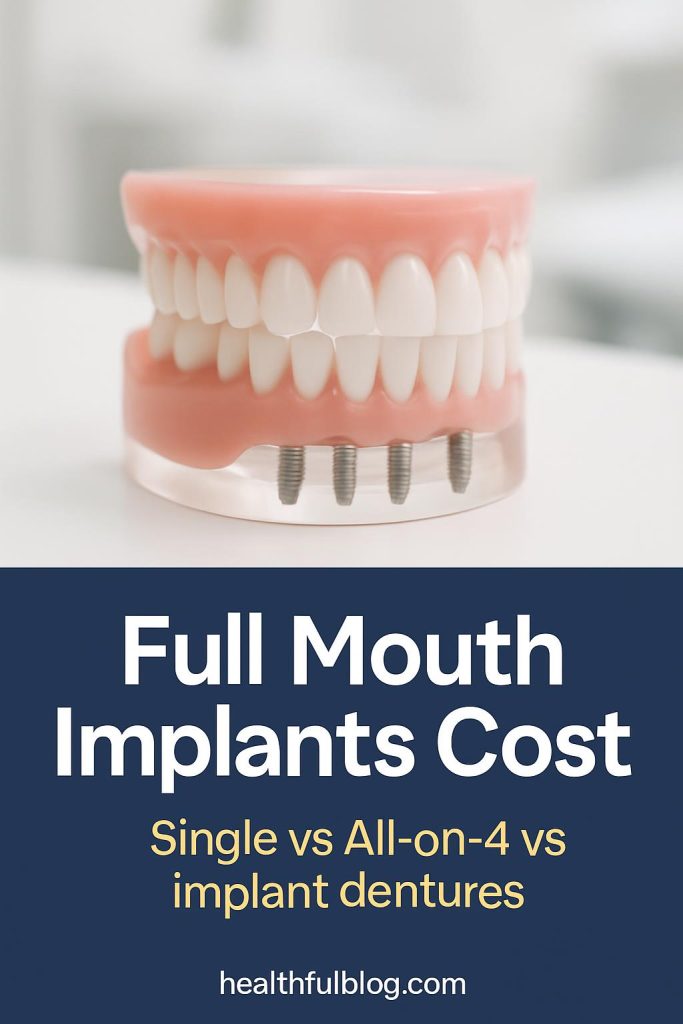
Two to four implants per jaw hold a removable denture through snap-on attachments or a bar. You take it out at night to clean it. This option fixes the main problem with conventional dentures, which is slipping, at a far lower cost.
Full mouth dental implant cost comparison
| Option | Typical cost per arch | Typical cost, both arches | Removable? |
|---|---|---|---|
| Implant-retained dentures | $2,000-$13,300 (avg. about $8,300) | Roughly double | Yes |
| All-on-4 fixed bridge | $11,600-$27,500 | $24,000-$55,000 | No (dentist only) |
| Full-mouth implants, fixed | Varies | $38,600-$90,000 | No |
| Individual implant crowns, all teeth | N/A | $60,000-$90,000+ | No |
| Conventional dentures (for comparison) | $1,360-$3,565 (avg. $2,085) | Roughly double | Yes |
Sources: NewMouth implant cost guide (May 2026) and Pearl Dental Costs (ADA fee survey data, May 2026). Prices vary widely by region and provider.
Single implants: why the per-tooth math adds up fast
Pearl’s national data puts the surgical placement of one implant (code D6010) at an average of $3,075, with a range of $2,005 to $5,255. That fee usually covers the post only. The abutment, the crown and any bone graft are billed separately. NewMouth’s all-in estimate is $3,000 to $5,600 per tooth.
Multiply that by 20 to 28 teeth and you can see why individual implants for a full mouth run into the tens of thousands. Many people also don’t have enough bone in every spot to hold an implant. For a deeper look at single-tooth pricing, see our guide to dental implant cost.
All-on-4: the fixed full-arch option
Pearl’s national data for All-on-4 shows a range of $14,720 to $38,610 and an average of $22,590. Pearl says a typical treatment runs about $20,000 to $30,000 per arch, and a single arch costs roughly half as much as a full mouth. NewMouth’s estimate is in the same range: $11,600 to $27,500 per arch and $24,000 to $55,000 for both.
A full All-on-4 quote usually includes 3D imaging, extractions, four implants per arch, a same-day temporary bridge, sedation, follow-up visits and the permanent bridge, which is placed after three to six months of healing. Pearl notes that the bridge itself may need replacing every 10 to 15 years. We cover the details in our All-on-4 dental implants cost guide.
Implant-retained dentures: the budget full-mouth option
Snap-in dentures cost a fraction of a fixed bridge. NewMouth estimates $2,000 to $13,300 per arch, with an average near $8,300, depending on how many implants you need and the type of attachment. For people with no lower teeth, the McGill consensus statement (2002) named a two-implant lower overdenture as the first-choice standard of care.
The trade-offs: you still remove and clean the denture every day, the attachments wear and need replacing, and the denture itself eventually wears out.
What drives the final price
- Extractions. A simple extraction averages about $260 nationally (Pearl). Surgical extractions cost more.
- Bone grafts and sinus lifts. NewMouth puts bone grafts at $549 to $5,148 per site. Sinus lifts for upper implants add anywhere from several hundred to several thousand dollars.
- Materials. The material and lab used for the final teeth affect the price.
- Sedation and imaging. IV sedation and CT scans may or may not be included in the quote.
- Provider and location. Specialists (oral surgeons, prosthodontists) and big-city practices tend to charge more.
- Number of implants. Each additional implant adds hardware, surgery time and lab work.
Insurance, Medicare and paying for it
Most dental plans won’t cover much of a full-mouth case. Pearl notes that many plans pay part of the extractions and a basic prosthesis, often about $1,500 to $2,000, but implants are often partly or fully excluded. Annual maximums are the main limit. According to the ADA, about a third of plans cap benefits at $1,000 to $1,500 a year.
Original Medicare does not cover dentures or implants in most cases. Medicare Advantage dental benefits help only a little: KFF found the average annual limit for extensive dental coverage was about $1,300 in 2021.
Some ways to lower the cost:
- Stage treatment across two calendar years to use two annual maximums.
- Pay with pre-tax HSA or FSA money. Dentures and dental treatment count as medical expenses under IRS Publication 502.
- Ask about university dental school or residency programs, which often charge reduced fees.
- Read medical credit card terms carefully. The CFPB found these cards often charge 26.99% interest, and deferred-interest promotions can backfire.
Book an evaluation if your dentures no longer stay in place, you have several failing or loose teeth, or you have trouble chewing enough to eat a balanced diet. After implant surgery, call your dentist promptly for swelling that worsens after a few days, fever, pus, bleeding that won’t stop, or an implant or bridge that feels loose.
Frequently asked questions
What is the cheapest way to get full mouth implants?
Implant-retained dentures on two to four implants per arch are usually the least expensive implant option, at about $2,000 to $13,300 per arch according to NewMouth.
Is All-on-4 cheaper than individual implants?
Yes, usually by a lot. All-on-4 uses four implants per arch instead of one per tooth, so it costs a fraction of the $60,000 to $90,000+ that individual implant crowns can run.
How long does full mouth implant treatment take?
All-on-4 treatment typically includes temporary teeth the same day, and the permanent bridge goes in after three to six months. Cases that need bone grafts take longer.
Will insurance pay for full mouth implants?
Usually only a small part. Plans may help with extractions and a basic prosthesis, but annual maximums of $1,000 to $2,500 cover only a small slice of a full-mouth case.
How long do full mouth implants last?
The implants themselves can last decades with good care. The teeth attached to them wear out: Pearl estimates All-on-4 bridges need replacing every 10 to 15 years.
Sources
- NewMouth, Types of Dental Implants and How Much Each One Costs
- Pearl Dental Costs, All-on-4 Dental Implants: National Cost
- Pearl Dental Costs, Dental Implants: National Cost
- Gerodontology, The McGill consensus statement on overdentures (2002)
- Medicare.gov, Dental Services
Save this guide for later on Pinterest