Last updated:
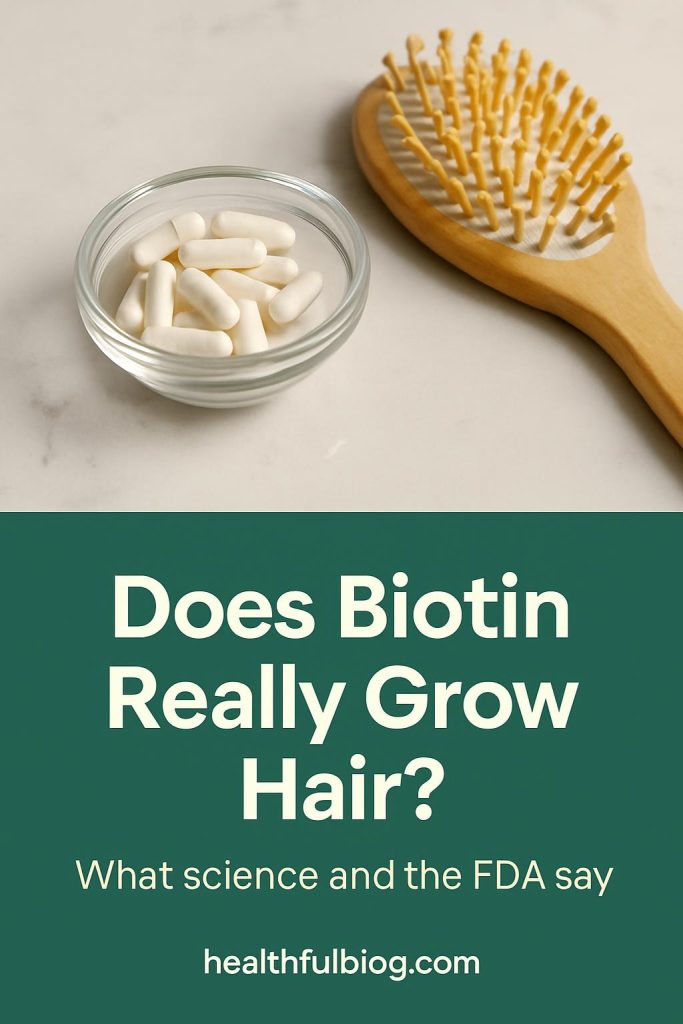
Biotin is the star ingredient in countless “hair, skin and nails” gummies, and it is easy to see why people try it: it is cheap, sold everywhere and sounds harmless. But does biotin for hair growth actually work? The short answer is that it helps people who are truly deficient, which is rare, and there is little evidence it does anything for everyone else. It also carries a risk most labels underplay: high doses can throw off important lab tests.
- Adults need about 30 mcg of biotin a day, and the NIH says most people get enough from food.
- Biotin deficiency can cause hair thinning, but it is rare; a review of published cases found biotin helped only people with an underlying problem.
- There is little scientific evidence that biotin supplements improve hair in healthy people.
- The FDA warns that biotin can cause falsely high or low results on some lab tests, including a heart attack test.
What biotin does in the body
Biotin, also called vitamin B7, helps enzymes break down fats, carbohydrates and proteins. According to the NIH Office of Dietary Supplements (ODS), the Adequate Intake for adults 19 and older is 30 mcg per day, rising to 35 mcg during breastfeeding.
You get biotin from ordinary foods. The ODS consumer fact sheet lists meat, fish, eggs and organ meats such as liver, seeds and nuts, and certain vegetables such as sweet potatoes, spinach and broccoli. It states plainly: “Most people get enough biotin from the foods they eat.”
Biotin deficiency and hair loss
True deficiency does affect hair. ODS describes symptoms that develop gradually, including “thinning hair with progression to loss of all hair on the body,” along with scaly red rashes, brittle nails, and neurological symptoms such as depression.
But deficiency is very uncommon. ODS identifies a few groups at higher risk:
- People with biotinidase deficiency, a rare inherited disorder that requires lifelong supplementation from birth.
- People with long-term heavy alcohol use, since alcohol inhibits biotin absorption; ODS notes about 15% of people with chronic alcoholism have low blood biotin.
- Pregnant and breastfeeding women; ODS reports that at least a third of pregnant women develop marginal biotin deficiency despite normal intake.
- People on certain antiseizure medicines for a year or more, which can significantly lower biotin levels.
If you are pregnant or recently gave birth and noticing shedding, keep in mind that postpartum hair loss is common and usually has nothing to do with biotin.
What the evidence shows for supplements
| Situation | Does biotin help hair? | What the evidence says |
|---|---|---|
| Confirmed biotin deficiency or biotinidase deficiency | Yes | Supplementation treats the deficiency and its symptoms |
| Certain rare inherited hair disorders in children | Possibly | Case reports only, at doses of about 3-5 mg/day |
| Brittle nails | Possibly | Three small, uncontrolled studies showed some improvement |
| Pattern hair loss or general thinning in healthy adults | No good evidence | No rigorous trials support use |
The most-cited summary is a 2017 review in Skin Appendage Disorders by Patel, Swink and Castelo-Soccio, which examined 18 reported cases of biotin use for hair or nails. In every case, the patient had an underlying condition behind the poor hair or nail growth, and all improved. The authors concluded there is a “lack of sufficient evidence for supplementation in healthy individuals” (abstract).
ODS reaches the same conclusion: for hair, skin and nails “there is little scientific evidence to support these claims,” and “more research is needed before biotin supplements can be recommended for any of these conditions.”
The lab test problem the FDA warns about
This is the most important practical reason to think twice. Many lab tests use biotin as part of the testing chemistry, so high levels in your blood can skew the result. The FDA states that biotin “can significantly interfere with certain lab tests and cause incorrect test results which may go undetected,” according to its page on biotin interference with troponin tests.
Troponin is a key blood marker used to diagnose heart attacks. The FDA says it has continued to receive adverse event reports of biotin causing falsely low troponin results, and it has published a list of cleared troponin tests still vulnerable to interference. In its November 2019 update, reported by Clinical Lab Products, the agency noted that many supplements, especially those marketed for hair, skin and nail growth, contain biotin levels up to 650 times the recommended daily intake.
Thyroid tests are another common problem. ODS notes that “even a single 10 mg dose of biotin” has interfered with thyroid function tests done within 24 hours. A falsely abnormal thyroid result can lead to unnecessary tests or the wrong treatment.
What to do: tell your doctor and the lab about every supplement you take, including multivitamins and prenatal vitamins, which often contain biotin. Ask whether you should pause it before blood work.
Is biotin safe otherwise?
Biotin has no established upper limit. ODS says no toxicity has been seen at doses as high as 200 mg a day. So the main risks are lab interference and wasted money, not direct harm.
That said, more is not better for hair overall. The American Academy of Dermatology (AAD) warns that getting too much of certain nutrients, including selenium and vitamins A and E, has been linked to hair loss. Many hair supplements stack these together. The AAD recommends talking to a dermatologist, who may order a blood test, before taking supplements for hair.
What works better for thinning hair
If your hair is thinning, the cause matters more than any supplement. Pattern hair loss responds to treatments with real evidence behind them, such as minoxidil and, for men, finasteride. Shedding after illness, stress or childbirth often recovers on its own, and low iron or thyroid problems need medical treatment.
For a broader look at nutrients, our guide to vitamins and minerals you should get daily explains which gaps are common. And for everyday care, see our tips for thinning hair.
See a doctor or board-certified dermatologist if you notice sudden or patchy hair loss, shedding along with a rash, brittle nails or fatigue, or thinning that continues for several months. Always tell your care team you take biotin before any blood test, and seek emergency care for chest pain regardless of any recent test result.
Frequently asked questions
How long does biotin take to work for hair?
If you are not deficient, there is no good evidence it will work at all. People with a confirmed deficiency improve as levels are corrected, under medical guidance.
Can biotin cause hair loss?
There is no evidence that biotin itself causes hair loss. But combination hair supplements may contain nutrients such as selenium or vitamin A, which the AAD links to hair loss in excess.
Should I stop biotin before a blood test?
Ask your doctor. ODS reports that a single 10 mg dose has affected thyroid tests within 24 hours, so your clinician may want you to pause it.
Is biotin in a multivitamin a problem?
Possibly. The FDA notes biotin is often found in multivitamins and prenatal vitamins, so mention them to your doctor and lab.
Sources
- NIH Office of Dietary Supplements, Biotin: Fact Sheet for Health Professionals
- NIH Office of Dietary Supplements, Biotin: Fact Sheet for Consumers
- FDA, Biotin Interference with Troponin Lab Tests
- Patel, Swink, Castelo-Soccio, A Review of the Use of Biotin for Hair Loss (Skin Appendage Disorders, 2017)
- American Academy of Dermatology, Hair loss: Tips for managing
Save this guide for later on Pinterest