Last updated:
If you or your child has just been told about a curve in the spine, one of the first questions is usually whether exercises for scoliosis can make it better. The honest answer is nuanced: exercise is good for general health and can ease back pain, but major medical sources do not describe it as a way to straighten the spine on its own. This guide explains what exercise can and cannot do, what the research on Schroth and similar programs actually shows, and when braces and specialist visits come into play.
- No high-quality evidence shows that physical therapy alone stops a scoliosis curve from progressing, according to AAOS OrthoInfo, so exercise is not a substitute for monitoring or bracing when a doctor recommends them.
- Scoliosis-specific exercise programs such as Schroth show small average changes in research, and the evidence has important limits.
- Walking, running and other regular activity are encouraged and generally safe, and exercise can help with back pain.
- A pediatric orthopedic or spine specialist should guide decisions about observation, bracing and surgery.
What exercise can and cannot do for scoliosis
Scoliosis is a sideways curve of the spine. In most adolescents the cause is unknown (idiopathic), and the curve may change as the child grows. Exercise affects muscles, posture, fitness and mood. It does not directly reshape the bones of the spine.
The American Academy of Orthopaedic Surgeons (OrthoInfo) says there is no high-quality evidence that physical therapy alone stops curve progression, and only low-quality research suggesting it may help a person appear straighter. It does note that physical therapy can be effective for managing back pain linked to scoliosis. The National Institute of Arthritis and Musculoskeletal and Skin Diseases (NIAMS) similarly says exercise programs have not been well studied but may help keep scoliosis from getting worse, and it encourages weight-bearing activities such as walking and running.
Can exercise fix scoliosis?
Searches such as “can exercise fix scoliosis” or “scoliosis exercises to straighten the spine” promise more than the evidence supports. No exercise routine has been shown to reliably reverse a structural curve, and any program that claims a guaranteed correction deserves skepticism. Mayo Clinic makes the same point about bracing: a brace will not cure scoliosis but may prevent it from getting worse, and its pages describe physical therapy as a way to strengthen the back, ease pain and improve posture.
A realistic goal for exercise is therefore broader: stay strong and active, support posture, manage discomfort, and feel confident in your body while the medical team tracks the curve.
Schroth and physiotherapeutic scoliosis-specific exercises
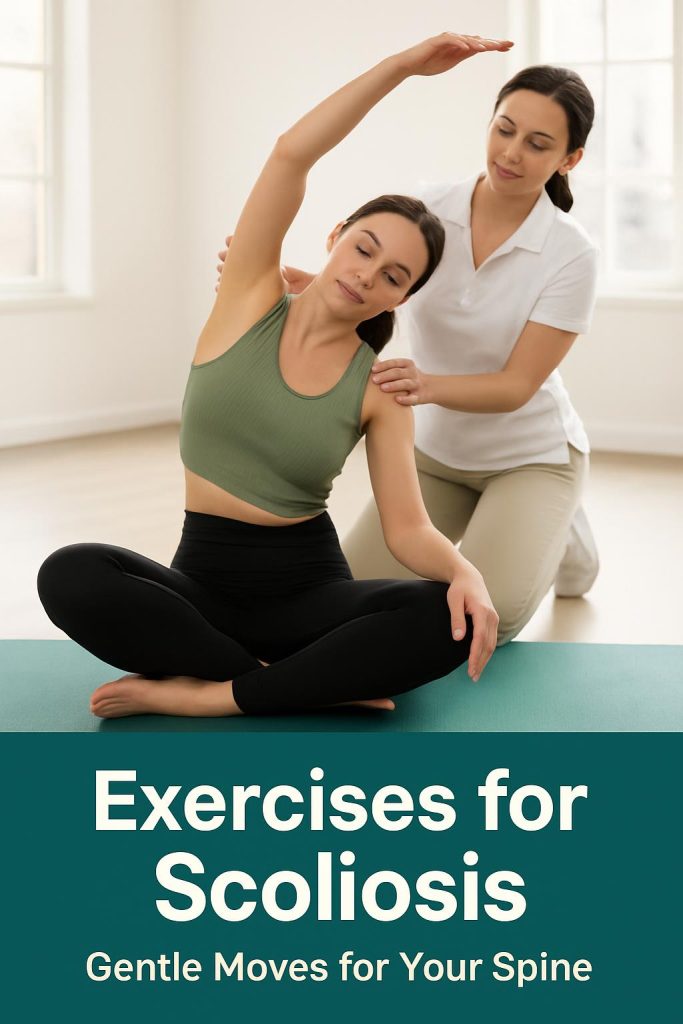
Physiotherapeutic scoliosis-specific exercises (PSSE) are programs taught by trained therapists, designed around an individual’s curve pattern. The best-known is the Schroth method, which combines targeted stretching, strengthening and breathing.
The international society for scoliosis rehabilitation, SOSORT, published 2016 guidelines that include recommendations on PSSE to prevent progression during growth. The guidelines report that a long-term randomized controlled trial found PSSE improved Cobb angles (the standard measure of curve size) at skeletal maturity in adolescents with idiopathic scoliosis. They also say PSSE can be performed two to seven times a week depending on the technique and the patient.
A meta-analysis in PeerJ pooled 11 randomized trials with 446 participants. It found a statistically significant Cobb angle reduction averaging about 3.2 degrees, which is below the 5 degrees often considered clinically meaningful. The authors rated the evidence as moderate quality, noted high risk of bias in most trials, and cautioned that the analysis did not account for natural progression of the curve. A separate systematic review of 12 studies (714 patients) on bracing combined with exercise reported benefits for curve angle and quality of life, but said the strength of conclusions was moderate and that current studies do not sufficiently support firm effects.
Taken together, PSSE looks promising as an add-on that some specialists support, but it is not proven to replace bracing or monitoring.
Scoliosis stretches and safe general activity
Many people ask about “scoliosis stretches.” No source reviewed for this article shows that a particular stretch corrects a curve, so treat stretching as a way to feel looser, not to fix the spine. What the sources do support is staying active.
- Walking, running and team sports: NIAMS encourages weight-bearing activity, and Mayo Clinic says exercise or playing sports may improve overall health and well-being.
- Core and back strengthening: Mayo Clinic describes therapy that strengthens the back and improves posture.
- Stop if it hurts: pain that is new, sharp or getting worse is a reason to pause and call your provider, not push through.
Whether any specific exercise or sport should be limited depends on the curve, age and any bracing, so ask your specialist rather than relying on generic “exercises to avoid” lists. Children in braces can typically take them off for sports, according to Mayo Clinic, but follow your own care team’s instructions.
| Approach | What major sources say |
|---|---|
| General exercise and sports | Encouraged for health and well-being; may help with back pain |
| Physical therapy alone | No high-quality evidence it stops progression (OrthoInfo) |
| Schroth / PSSE | Small average Cobb angle changes in trials; limits in study quality |
| Bracing | Can keep curves from growing enough to need surgery when worn as prescribed |
| Chiropractic care | May help back pain; not shown to reduce or prevent progression (OrthoInfo) |
Bracing and monitoring basics
Most mild curves are simply watched. OrthoInfo says growing children with curves under 20 degrees are typically monitored every 6 to 12 months. Mayo Clinic notes that X-rays are generally repeated about every 6 months during growth phases. SOSORT adds that observation can include regular clinical evaluation without taking an X-ray each time.
Bracing is generally considered for moderate curves in children who are still growing. OrthoInfo says braces are usually prescribed for curves between 20 and 40 degrees, and that wearing a brace for only 6 hours a day is nearly useless. Mayo Clinic says most children wear braces 13 to 18 hours a day, and some night-only designs exist for certain curves. NIAMS says research shows braces work well when the child is still growing and wears them as directed, and bracing usually stops once growth is complete.
Surgery is usually discussed for larger curves. OrthoInfo says it is typically recommended for curves greater than 50 degrees, and it notes that curves above 50 degrees tend to worsen by about 1 degree per year.
When to see a specialist
A primary care provider or pediatrician can screen for scoliosis, but Mayo Clinic notes that pediatric orthopedic surgeons specialize in treating children with it, and OrthoInfo advises seeing an orthopedic spine specialist even if you also use chiropractic care. A good first visit usually covers the curve measurement, how much growth remains, and a follow-up schedule.
See a doctor if you notice uneven shoulders, a prominent shoulder blade, uneven waist or hips, or a rib prominence when bending forward, especially in a growing child. Seek prompt care for back pain that is severe, worsening or waking you at night, or for numbness, weakness or changes in bladder or bowel control. Do not delay a recommended visit, brace or follow-up X-ray in favor of exercise alone.
Frequently asked questions
Can exercise fix scoliosis?
There is no good evidence that exercise alone fixes or reverses a structural curve. It can support strength, posture and comfort, and some programs may help limit progression, but major medical sources do not present it as a cure.
What are the best exercises for scoliosis?
Regular activity such as walking or running is encouraged for general health, and a therapist trained in scoliosis-specific exercise can tailor a program to your curve.
Are Schroth exercises worth trying?
Trials show small average improvements in Cobb angle, but the studies have limits. Talk with your specialist about whether Schroth fits alongside monitoring or bracing.
Are there scoliosis exercises to avoid?
The sources reviewed do not publish a single list of banned exercises. Stop anything that causes pain and ask your orthopedic specialist or therapist for guidance specific to your curve.
Does scoliosis get worse in adulthood?
Some curves do. OrthoInfo says curves over 50 degrees tend to worsen by about 1 degree per year, while fully grown patients with curves under 30 degrees typically stay stable.
Sources
- AAOS OrthoInfo, Nonsurgical Treatment Options for Scoliosis
- NIAMS, Scoliosis in Children and Teens: Diagnosis, Treatment, and Steps to Take
- Mayo Clinic, Scoliosis: Diagnosis and Treatment
- SOSORT, 2016 Guidelines: Orthopaedic and Rehabilitation Treatment of Idiopathic Scoliosis During Growth
- PeerJ, Effectiveness of Schroth Exercises for Adolescent Idiopathic Scoliosis: A Meta-Analysis
- PubMed, Bracing Combined With Exercise-Based Treatment of AIS: A Systematic Review
Save this guide for later on Pinterest